Sunday, July 17, 2016

Biotechnology and Art

The microvenus project by Joe Davis was the first
non-biological message encoded in DNA
Of the major sciences, the discipline of biotechnology integrates with art as seamlessly as any other. Joe Davis is the pioneer who first mixed biotech and art. Davis is an artist who convinced scientists to teach him how to synthesize DNA and insert it into a living genome. Davis often came up with ideas that scientists considered extremely dangerous and crazy. As scrutinized as most of his ideas are, he poses important questions about the meaning of life and breaks boundaries that most people are afraid to venture into. His most popular work is genetically engineering and sending a message to potential extra-terrestrials into space using the E. coli bacteria of a microvenus.

A consumer chemistry set demonstrates how
easy it is for DIY experiments
While amazing things like the double helix DNA structure can be accredited to biotech and art, it is still a very controversial topic with many dangerous aspects. There is much scrutiny with the emerging do it yourself (DIY) biotech practices from curious people playing around with at home lab equipment in their garage. A very real threat is possible with someone playing around with the wrong mixture of materials and creating a superbug that scientists are unable to cure. Because this is such a new industry with lab equipment becoming cheaper and more accessible to the amateur scientist, there are no strict restrictions and limitations in the law.
Federal agents in hazmat suits raid
Steve Kurtz house


Artist Steve Kurtz was arrested in 2004 after calling 911 to report the death of his wife when police discovered his at home lab of petri dishes containing biological specimens for an art project of his. Kurtz was later released when the Commissioner of Public Health for New York State deemed that nothing in the home posed a dangerous threat. In order to ensure public safety there needs to be more stringent rules for artists and scientists that work with biotech unsupervised. Although their intentions may not be malicious, there are still very real possibilities of a mistake in the lab occurring and creating a hazardous unstoppable virus. It would be much safer if there were regulations that made sure artists worked in approved spaces that are able to contain any such mistakes that may occur.


Sources:

Vesna, Victoria. "Biotech and Art." Web. 8 May 2016. 
Levy, Ellen K. Defining Life: Artists Challenge Convetional Classification. PDF.
Kelty, Chris. Meanings of Participation: Outlaw Biology? PDF.
Washington Post. The Washington Post, n.d. Web. 18 July 2016.
Schuler, Barry. "Genomics 101." TED. June 2008. Web. 8 May 2016.

Images:

Agapakis, Christina. "Communicating with Aliens through DNA." Scientific American Blog Network. N.p., n.d. Web. 18 July 2016.
"Strontium." Pictures, Stories, and Facts about the Element in the Periodic Table. N.p., n.d. Web. 18 July 2016.
"Research Is Not Terrorism: Steve Kurtz | Arts Catalyst." Research Is Not Terrorism: Steve Kurtz | Arts Catalyst. N.p., n.d. Web. 18 July 2016.

Sunday, July 3, 2016

Medicine + Technology + Art

A man-made physical structure displaying tensegrity
with a geodesic form
A microtubule filament of the cytoskeleton displaying
a geodesic form

This week’s lecture materials covered topics relating to medicine and art, ranging from the relevancy of the Hippocratic oath, to using the MRI as an art form. One topic that was most influential was the writing of Donald E. Ingber with his piece The Architecture of Life. In Ingber’s writing he discusses the building blocks of organic and inorganic structures, and how an architectural term tensegrity is being used to explain the geodesic forms that can be seen in everything. He explains everything from the microscopic structures of cells in our bodies to discussing the idea that even the solar system could be, “a structure composed of multiple non-deformable rings of planetary motion held together by continuous gravitational tension” (Ingber). The concluding idea in his piece being that, “perhaps there is a single underlying theme to nature after all” (Ingber). Art seems to be flawlessly relevant with biology and medicine when studying visual models and structures. The research into self-assembly of molecules, to how they have influenced architectural structures is an extremely interesting topic that will one day be integral to understanding how everything in the universe came to be.
A plastinated human body by Gunther Von Hagens
displaying the visual power of combining art with science
In her lecture, Professor Vesna discussed the work of Gunther Von Hagens, a German scientist who invented the technique of plastination by using polymers and plastics to preserve biological specimens. This method combined science and art to invent a modern mummification that re-animated a dead human body into an art piece that could be viewed by the general public. Von Hagens has delved into fusing art and science in 2002 when he performed the first public autopsy in the UK in 170 years to a sell-out audience in the London theatre. Despite receiving a letter detailing the criminal acts of his performance from Her Majesty's Inspector of Anatomy, who is the British government official responsible for regulating the educational use of cadavers, Von Hagens still performed the autopsy. Metropolitan police attended the show, but they did not intervene and the full autopsy was performed. Art and science flawlessly work together with the examination of body parts, as shown with the great public interest in Von Hagen’s show. People are greatly fascinated with the functions of human bodies and cells, and the use of art to reproduce and display cellular structures, or full human bodies is an incredibly useful tool to teach the public how they’re body’s work, and for scientists to study and learn more about relevant topics.


Sources:

"BBC NEWS | Entertainment | Watchdog Clears TV Autopsy." BBC News. BBC, 2003. Web. 03 July 2016.

"Tensegrity." - Scholarpedia. N.p., n.d. Web. 03 July 2016.

"A Life in Science." Gunther Von Hagens. N.p., n.d. Web. 03 July 2016.

Vesna, Victoria. "Medicinept1." Online video clip. YouTube. Youtube, 21 Apr 2012. Web. 29 Apr 2016.


Vesna, Victoria. "Medicinept3." Online video clip. YouTube. Youtube, 21 Apr 2012. Web. 29 Apr 2016.

Images:

"Gunther Von Hagens and the Plastination." - Dark Art Blog. N.p., n.d. Web. 04 July 2016.

"Donald E. Ingber | Mediander | Topics." Mediander. N.p., n.d. Web. 04 July 2016.

"Browse By Theme." Tensegrity. N.p., n.d. Web. 04 July 2016.


Friday, July 1, 2016

Robotics + Art


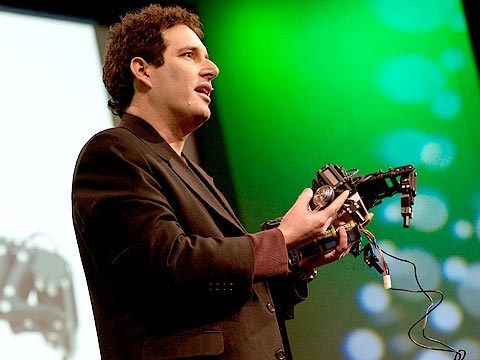
Hod Lipson holding a primitive AI that self-learned
 the ability to walk
In a few words, Moore’s law states that computational power doubles approximately every two years.  With this increasing rate of computing power, the human species is on the brink of a technological singularity. Scientists and computer programmers are getting closer than ever to creating a true artificial intelligence. In Hod Lipson’s TED talk, Building “self-aware” robots, he says that, “ we have to get away from this idea of designing these machines manually, but we have to let them evolve and learn by themselves like children.” In his 2007 talk he demonstrates the capabilities of the technology 10 years ago, by being able to create machines that have no programmed understanding of their physical body, but can learn and analyze their body and attempt to physically walk forward. Ten years ago scientists were building robots that had the abilities of self-learning and self-replication, Moore’s law says that this computational power is exponentially growing, and it’s only a matter of time until true AI is achieved.

Professor Machiko Kusahara talked about Japan’s early influence on the robotics world by creating humanoid robots, contrasted to America’s early robots with Ford that were created with an industrial mindset of factory optimization. Japan wished to make robots that were appealing to humans for the use of taking care of the elderly, or for rescue in a natural disaster. The famous animation hero Astroboy was a robot that was given human emotions and ethics, which all tied into Japan’s notion that robots are friends. Astroboy is an art piece by Japanese comic book writer Osamu Tezuka that integrated an intelligent robot into human life that was praised for his consistently saving lives. This is an optimistic viewpoint of how AI's will be treated in the future.

The famous Japanese animation Astroboy depicting a robot boy with inhuman powers,
having very human characteristics, like wearing normal clothes


A man in a suit with a whip
treats a robot like a slave


When the first truly artificial intelligent robot is realized society will be awe struck. It will truly be a work of art, replicating the human mind itself. As magnificent as this day will be, history has shown that it will quickly be shadowed by industrialization. In The Work of Art in the Age of Mechanical Reproduction by Walter Benjamin, he talks about how technology has given us the power of reproducing beautiful pieces of artwork, but in the process has diminished authenticity saying the, “total function of art is reversed, instead of being based on ritual, it’s based on politics." The first truly artificial intelligence will be an amazing piece of artwork, but it will quickly become an item of mass production in order to create a product that will generate economic profit. 


Sources:

Benjamin, Walter. The Work of Art in the Age of Mechanical Reproduction. London: Penguin, 2008. Print.

Vesna, Victoria. “CoLE.” CoLE. N.p.. Web. 18 Oct 2012. <https://cole.uconline.edu/~UCLA-201209-12F-DESMA-9-1

"Building "self-aware" Robots." Hod Lipson:. N.p., n.d. Web. 01 July 2016.

"The Lives and Death of Moore's Law | Tuomi | First Monday." The Lives and Death of Moore's Law | Tuomi | First Monday. N.p., n.d. Web. 01 July 2016.

Uconlineprogram. "Robotics MachikoKusahara 1." YouTube. YouTube, 2012. Web. 01 July 2016.


Images:

"Astro Boy." Heroes Wiki. N.p., n.d. Web. 01 July 2016.

"Man > Robot." Photobucket. N.p., n.d. Web. 01 July 2016.

"Building "self-aware" Robots." Hod Lipson:. N.p., n.d. Web. 01 July 2016.

Saturday, June 25, 2016

Math + Art

This week’s lecture by Professor Vesna focused on the impact that math and art have had on each other throughout history and present day. I have always had an interest in how almost everything in the world could be explained with some sort of mathematical combination. How data could be mapped out and manipulated to offer many insights to the world, like how Amazon has a feature that sends a customer items automatically based on past transactions. Another example I’ve been interested in is how any class of student’s grades could be represented accurately by a normal distribution curve. I have never looked too deeply into these ideas, but this week’s content offered some really interesting insights into how closely art and math complement each other.

Linda Dalrymple Henderson’s “The Fourth Dimension and Non-Euclidian Geometry in Modern Art,” explains how the idea of a fourth dimension was a huge impact among artists in the first three decades of the twentieth century. It astonishes me how these artists represented and argued for this idea that still holds many questions today. How do you represent the fourth dimension in an artistic piece? Many fantastic artworks tackle this abstract framework, like this artwork of Jesus by Salvador Dali called, "Corpus Hypercubes." Dali puts Jesus on a hypercube cross, fusing dimensional space science with religion. It seems paradoxical at first to think of artists representing the fourth dimension, as art is supposed to minimize our third dimensional world onto a lesser two dimensional medium. One example that resonated with me was that of Dominguez who used a lion to explain his idea that time is the primary definition of the fourth dimension, putting the lion into a manipulative frame that encompasses its life from birth to death, creating a super lion. 


I was fairly familiar with the Mandelbrot set from high school math classes, but never did we analyze it from an artistic perspective. It’s amazing how math can be seen anywhere in the world, especially in the Mandelbrot set, a fairly simple mathematical formula (z = z^2 + c), containing an infinite amount of geometric shapes. Theoretically, if the Mandelbrot set is infinite, then every shape and pattern in the universe could be contained in this one simple set of variables that make up an abstract piece of art.


Sources


Henderson, Linda Dalrymple. "The Fourth Dimension and Non-Euclidean Geometry in Modern Art: Conclusion." Leonardo 17.3 (1984): 205-10. Web. 10 Apr. 2016.

Vesna, Victoria. “Mathematics.” Lecture. CoLE DESMA 9. Web. <https://cole.uconline.edu/~UCLA-201209-12F-DESMA-9-1#l=Week-2-Assignment/id4287887>.

"The Fourth Dimension in Painting: Cubism and Futurism." The Peacocks Tail. N.p., 2011. Web. 25 June 2016.

"Unveiling the Mandelbrot Set." Plus.maths.org. N.p., n.d. Web. 25 June 2016.

"Mandelbrot Set." Wikipedia. Wikimedia Foundation, n.d. Web. 25 June 2016.